Weekly Macro & Liquidity Updates
Real-time summaries of global liquidity dynamics, exchange flow indicators, and sentiment regimes.
Bitcoin Macro Cycle Bottom Projections
As Bitcoin continues to navigate its corrective phase, several MarketScanner models are beginning to converge on areas of significant interest for a potential macro cycle low.
While the precise calculations and internal weighting of our proprietary model suite remain exclusive to MarketScanner subscribers, current model outputs suggest that Bitcoin is approaching a historically important accumulation region.
Our MarketScanner Decay Model currently identifies the 36,500–37,500 region as the highest-probability bottom zone based on the present market structure.
Timing the Bottom: Diverging Paths, Different Outcomes
One of the most notable developments is the divergence emerging between two independent timing frameworks.
The Historical Cycle Model, which studies previous Bitcoin market cycles, continues to indicate a potential bottoming window around October 2026, consistent with the tendency for Bitcoin to form major cycle lows approximately one year after a macro peak.
Meanwhile, the MarketScanner GRM Pro Model is signaling the possibility that the current correction could mature considerably sooner, potentially within the coming weeks.
While these models currently disagree on timing, they collectively highlight an important conclusion: The timing of the bottom may ultimately determine the depth of the correction.
An accelerated bottoming process would likely support a higher low within the primary support region. Conversely, if the correction extends toward the historical October cycle window, the projected support range from the GRM Pro framework continues to drift lower over time, increasing the probability of a deeper retracement.
Fibonacci Confluence and Structural Support
Adding further weight to the broader accumulation thesis is the macro Fibonacci retracement structure.
The 0.618 Fibonacci retracement and the Golden Pocket (0.65) currently reside between 32,000 and 34,000.
While this region sits below our primary support projection, it remains a significant secondary support zone and represents a plausible tail-risk scenario should the correction continue for an extended period. From a high-timeframe perspective, this area would likely attract substantial market attention if tested.
Scenario Analysis
| Scenario | Timing Window | Expected Bottom Zone |
|---|---|---|
| Accelerated Bottom | Next few weeks | 36,500–37,500 |
| Historical Cycle Bottom | October 2026 | 32,000–34,000 becomes increasingly probable |
MarketScanner Macro Summary
*This update is provided for research and educational purposes only and does not constitute financial advice. All market analysis represents probabilistic scenarios rather than predictions or guarantees.*
Western Session Coinbase Premium Turnaround
Spot buying pressure on Coinbase Pro has outpaced Binance for four consecutive days. This turns the Coinbase Premium Index positive and indicates strong Western institutional accumulation during US trading hours.
Derivative Funding Rate Normalization
Perpendicular funding rates across SOL, ETH, and BTC have fully normalized back to baseline levels (0.01% per 8h). This shows the removal of leveraged long froth, establishing a healthy base for the next expansion.
Quantitative Research Reports
In-depth statistical analysis on exchange capital distributions, token flows, and derivatives hedging metrics.
Stablecoin Supply Ratio (SSR) Oscillator Exhaustion & Supply Crunch
The Stablecoin Supply Ratio (SSR) measures the purchasing power of stablecoins relative to the market cap of Bitcoin. Our proprietary SSR Oscillator has touched historical exhaustion bands, indicating that sidelined stablecoin capital on spot exchanges is near maximum capacity. This buying power potential, combined with plummeting exchange BTC reserves, suggests an imminent supply-side squeeze.
Key Research Findings
- 📉 Exchange Supply Crunch: Total Bitcoin held across tier-1 spot exchange reserves has hit a multi-year low of 1.72M BTC, significantly reducing market depth for sudden selling waves.
- 💰 Sidelined USD Dry Powder: Verified stablecoin reserves on-exchange have increased by $4.2B over the past 30 days, representing a high-potential coiled spring.
- 🐳 Whale Cohort Behavior: On-chain wallet analytics indicate addresses holding >100 BTC continue their net accumulation posture, while smaller retail wallets (<1 BTC) are distributing.
Bitcoin Macro Cycle Studies & Modeling
Halving epoch regression, power-law models, and diminishing returns curve projections.
MarketScanner Slope Decay Network Projections
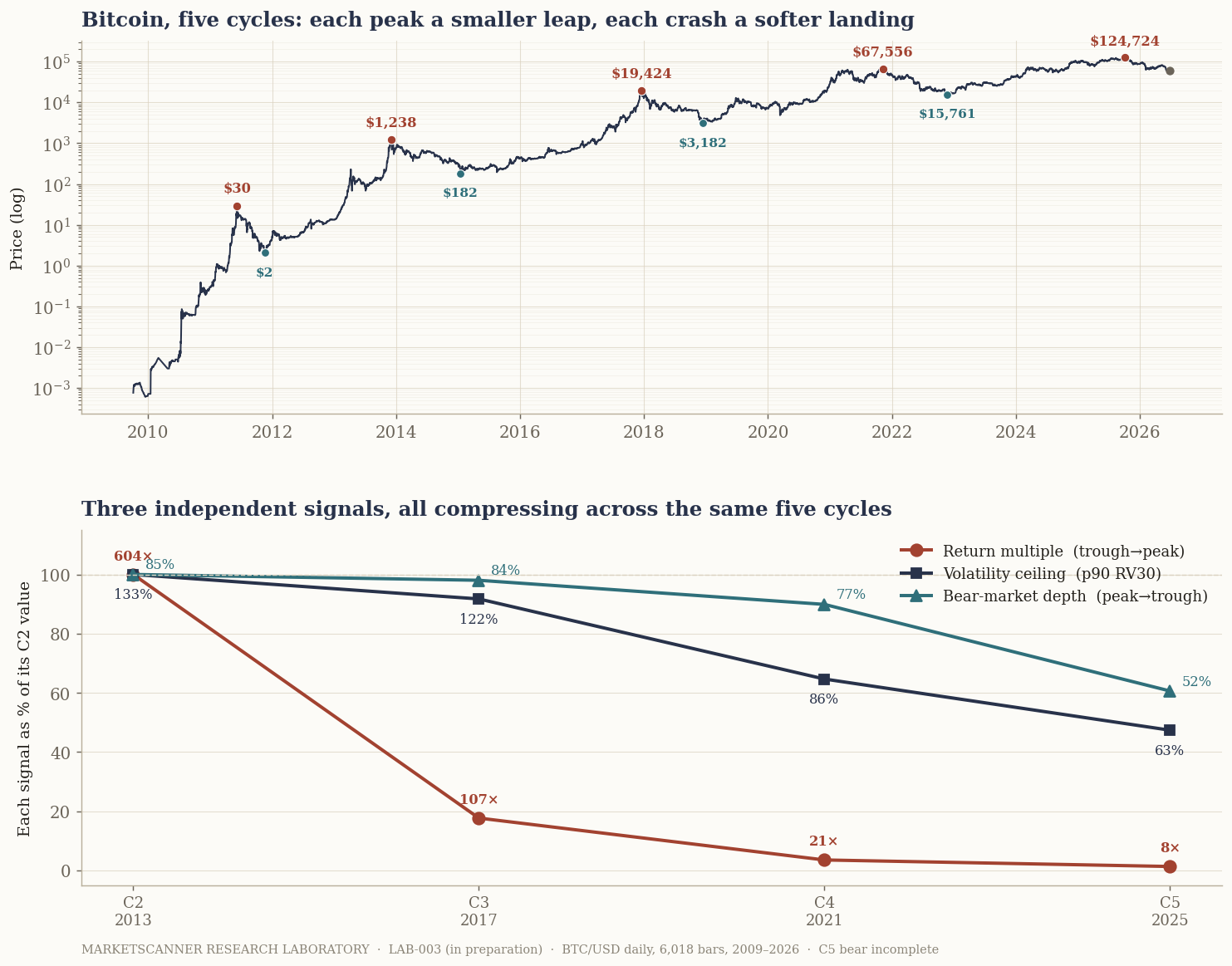
The MarketScanner Slope Decay Network models the diminishing rate of returns in each successive halving epoch by measuring the price slopes across cycles. Based on logarithmic regression curves, Epoch 4 (2024-2028) projects a macro cycle peak between **$172,000** and **$218,000**.
Professional Trading Systems
Technical playbooks, algorithmic entry mechanics, and structural execution guides.
Mastering Ichimoku Cloud Breakouts & TK Clamps
The Ichimoku Kinko Hyo system is a comprehensive trend-following methodology. This guide focuses on identifying high-probability breakouts by isolating Tenkan-Sen (Conversion Line) and Kijun-Sen (Base Line) crossovers above the Kumo Cloud.
Step-by-Step Entry Protocol
Pine Script v6 Entry Condition Snippet
tenkan = ta.sma((ta.highest(9) + ta.lowest(9)) / 2, 1)
kijun = ta.sma((ta.highest(26) + ta.lowest(26)) / 2, 1)
senkou_a = ((tenkan + kijun) / 2)[26]
senkou_b = (ta.sma((ta.highest(52) + ta.lowest(52)) / 2, 1))[26]
// 2. Define TK cross & cloud alignment rules
tk_cross_up = ta.crossover(tenkan, kijun)
price_above_cloud = close > math.max(senkou_a, senkou_b)
chikou_clear = close > close[26]
long_entry = tk_cross_up and price_above_cloud and chikou_clear